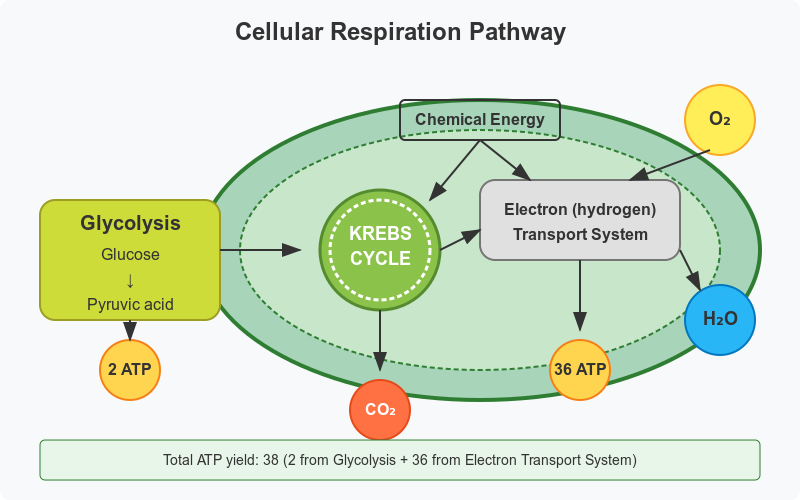
AP Biology Cellular Respiration: Key terms, Definition & Processes
Recovered historical Refresh Kid article. Original dates and context are retained; this version awaits editorial review.
Cells need energy to function, and they get it through cellular respiration. This process converts glucose into ATP, the molecule that powers everything from muscle movement to brain activity. In this guide, we'll break down cellular respiration into simple, easy-to-understand steps so you can master this important AP Biology topic.
What Will You Learn in This Guide?
By the end of this blog, you’ll understand:
What cellular respiration is and why it’s important
The three main stages: Glycolysis, Krebs Cycle, and Electron Transport Chain
Key terms and their definitions
How ATP is made step by step
The difference between aerobic and anaerobic respiration
Helpful study resources to strengthen your understanding
Every living thing relies on cellular respiration to stay alive. Let’s take a closer look at how it works!
What Is Cellular Respiration?
Cellular respiration is the process where cells convert glucose into energy (ATP) using oxygen. This energy is used for essential life functions like muscle contractions, nerve signals, and even cell repair.
Equation for Cellular Respiration
What this means:
Glucose (C₆H₁₂O₆) and oxygen (O₂) are used as fuel.
The process produces carbon dioxide (CO₂), water (H₂O), and ATP (energy).
Key Terms and Definitions
Term
Definition
ATP (Adenosine Triphosphate)
The main energy carrier in cells.
Glucose
A simple sugar that serves as fuel for cellular respiration.
Glycolysis
The first stage of respiration, where glucose is split into pyruvate.
Krebs Cycle (Citric Acid Cycle)
A series of reactions that generate high-energy molecules (NADH, FADH₂).
Electron Transport Chain (ETC)
The final stage where most ATP is produced.
NADH and FADH₂
Electron carriers that help generate ATP.
Aerobic Respiration
Respiration that requires oxygen.
Anaerobic Respiration
Respiration that happens without oxygen, producing less ATP.
Mitochondria
The "powerhouse" of the cell where most of cellular respiration takes place.
ATP Synthase
The enzyme that produces ATP in the ETC.
Stages of Cellular Respiration
There are three major stages in cellular respiration:
Stage
Location
Main Function
ATP Produced
Glycolysis
Cytoplasm
Splits glucose into pyruvate
2 ATP
Krebs Cycle (Citric Acid Cycle)
Mitochondrial Matrix
Produces high-energy electron carriers
2 ATP
Electron Transport Chain (ETC)
Inner Mitochondrial Membrane
Uses electrons to generate ATP
32-34 ATP
Now, let's break each stage down further
Stage 1: Glycolysis – Breaking Down Glucose
✅ Where does it happen?Cytoplasm✅ What happens?
One glucose molecule (C₆H₁₂O₆) is split into two pyruvate molecules.
2 ATP molecules are invested to start the process.
4 ATP molecules are made (net gain: 2 ATP).
2 NADH molecules store electrons for later use.
Steps of Glycolysis
Step
What Happens?
Products
Glucose Breakdown
Glucose is split
2 Pyruvate
ATP Investment
2 ATP used
Activation Energy
ATP Production
4 ATP made
Net 2 ATP
Electron Carrier
NADH stores electrons
2 NADH
✅ Oxygen needed? ❌ No, glycolysis is anaerobic (does not require oxygen).
Want to improve your understanding of cellular respiration? Check out our AP Biology course:➡️ Schedule an introductory conversation➡️ AP Biology Full CourseFor additional practice questions, try College Board’s AP Biology Free-Response Questions.Understanding cellular respiration is key for AP Biology. Keep practicing, and you’ll be ready for your next exam!
One-on-one support Built around your studentLet’s talk →