AP Classes, Dual Enrollment, and Electives: Middle School Parents Guide
Recovered historical Refresh Kid article. Original dates and context are retained; this version awaits editorial review.
Helping your child plan their high school journey can feel overwhelming. Terms like AP Classes, Dual Enrollment, and Electives get thrown around a lot, but what do they actually mean? More importantly, how can you help your middle schooler make the best decisions?In this guide, we break down everything parents need to know about these options, including the difference between electives and AP classes, what dual enrollment is in high school, and how to compare college credit AP vs dual enrollment. You’ll also get tips on how to choose electives in high school and understand the benefits of dual enrollment.To dive deeper into AP programs, visit our AP Course Guide on Refresh Kid.
What Are AP Classes in High School?
AP stands for Advanced Placement. These are college-level classes offered in high school.
Available in subjects like AP Biology, AP Calculus, AP US History, and more
Students take an AP exam at the end of the course
High scores (usually 3 or above) may earn college credit
Example:
If your child takes AP Chemistry in 11th grade and scores a 4 on the exam, many colleges will give them credit as if they had completed a first-year college chemistry class.
Benefits of AP Classes:
Show academic rigor on college applications
Opportunity to earn college credits and save on tuition
Prepare students for the pace and expectations of college
Help qualify for scholarships and advanced placement in college courses
Tip:
Some high schools have prerequisites. For example, a student may need to complete Algebra II before taking AP Calculus AB.
How to Register:
Students typically register for AP classes through their high school counselor during course selection. To register for AP exams, schools usually coordinate directly with the College Board. For homeschool or independent students, visit the College Board AP Registration Page for guidance.
What Is Dual Enrollment in High School?
Dual Enrollment allows high school students to take real college courses, either at a local college or online.
Key Features:
Students earn both high school and college credit at the same time
Typically available to juniors and seniors
Usually offered through local community colleges or universities
Example:
A 12th grader might take an English Composition course at a local community college. This course counts as both high school English credit and college credit.
Benefits of Dual Enrollment:
Save money on college tuition
Get a real taste of college life and academics
Flexible options, including online and in-person classes
Registration varies by state and college. Typically, students work with their high school counselor to apply to a local partner college or university. Some programs require placement tests. For example, students in California can register through their community college system via CCCApply, while Florida students use FloridaShines.
Difference Between Electives and AP Classes
Understanding the difference between electives and AP classes is key to making smart decisions.
Electives:
Courses chosen based on interests (e.g., art, photography, journalism, coding)
Help students explore hobbies, passions, or career paths
Typically do not provide college credit
AP Classes:
Rigorous academic classes
Align with college-level standards
Students take an exam to potentially earn college credit
Summary:
Feature
Electives
AP Classes
Purpose
Explore interests
Academic rigor + college credit
Credit
High school only
Possible college credit
Difficulty
Varies
College-level
AP Classes vs Dual Enrollment: What’s Better?
Comparing AP classes vs dual enrollment can help you choose the best path for your child.
AP Classes:
High school teacher teaches the course
Credit depends on AP exam score (1 to 5 scale)
Recognized nationally and internationally
Dual Enrollment:
Actual college professor teaches the course
Credit earned based on course grade (no separate exam)
Credits may not always transfer across all colleges
Not sure how to choose electives in high school? Here's a step-by-step guide for parents.
Step-by-Step Guide:
1. Think About Interests
Is your child artistic? Try graphic design or theater.
Do they love science? Consider robotics or environmental science.
2. Explore Career Skills
Courses like business, coding, or public speaking can build real-world skills.
3. Balance Fun and Academics
It’s okay to have a mix! A fun elective can keep school exciting.
4. Ask About Future Courses
Some electives lead to advanced classes in later grades (e.g., Intro to Computer Science → AP Computer Science A).
5. Talk to the School Counselor
They can help match electives with graduation requirements and college goals.
Students can also test the waters with enrichment programs like those offered in Refresh Kid's Summer Prep Courses.
Benefits of Dual Enrollment for College Preparation
The benefits of dual enrollment go beyond just saving money.
Academic Benefits:
Exposure to college-level work
Develop college-level writing and thinking skills
Learn how to manage a syllabus and deadlines independently
Financial Benefits:
Fewer credits needed in college
Reduce student loan debt
Qualify for state or federal programs supporting early college programs
Emotional Growth:
Build confidence
Experience new environments
Meet a diverse group of peers
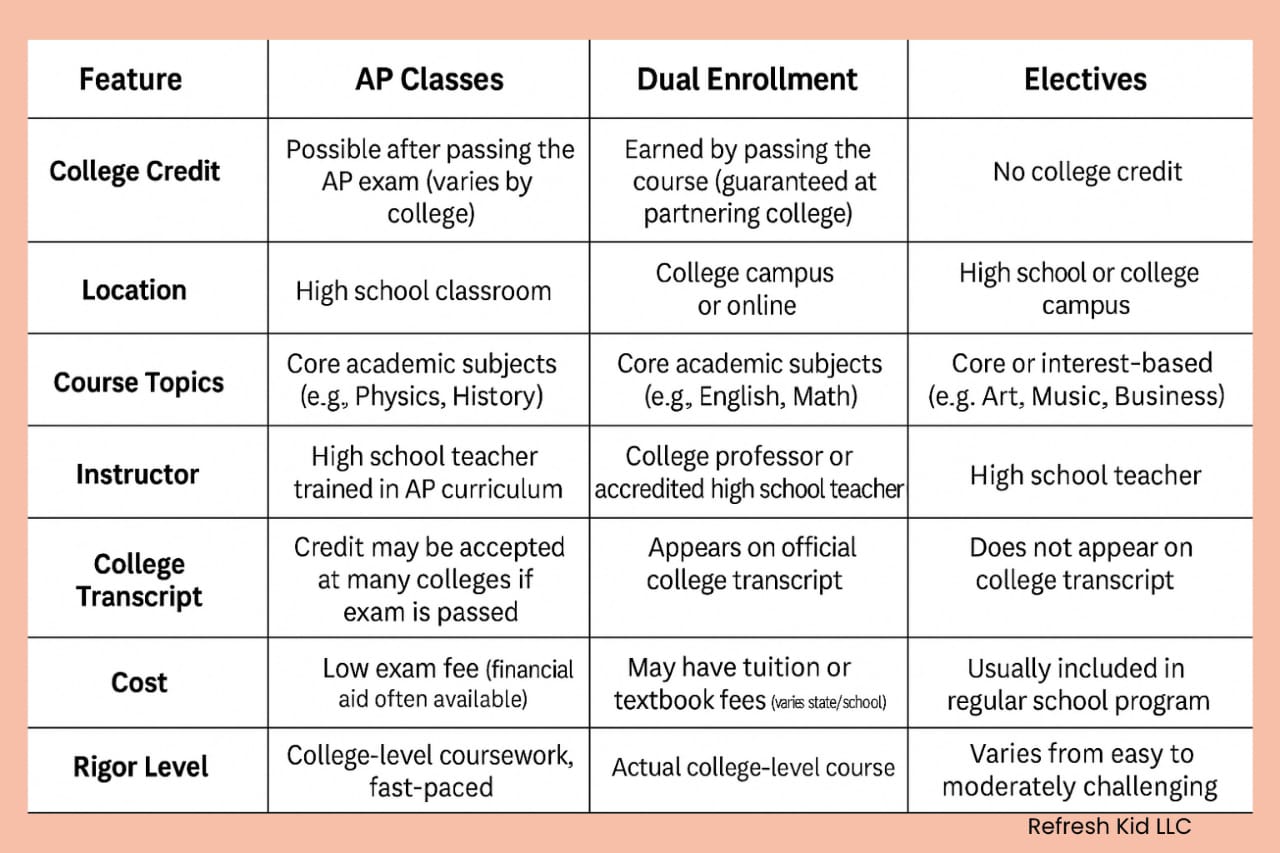
Summary Table: AP Classes vs Dual Enrollment vs Electives
Feature
AP Classes
Dual Enrollment
Electives
Purpose
College-level academic challenge
Earn college credit while in high school
Explore interests and develop soft skills
Taught By
High school teachers
College professors (or approved instructors)
High school teachers
Credit Type
High school + potential college credit (via exam)
High school + direct college credit
High school credit only
Credit Basis
AP exam score (1–5)
Final course grade
Course completion
Recognition
National/international
Varies by state/college
Internal (school-specific)
Cost
Usually free or low-cost
May involve tuition or fees
Free as part of high school schedule
Transferability
Widely accepted by colleges
Depends on college/state
Not intended for college transfer
Scheduling
Within high school schedule
May require travel or online attendance
Built into school day
Registration
Through high school counselor, AP exam via College Board
Via counselor and college application (e.g., CCCApply)
High school course selection period
How Can Middle School Parents Help Prepare for High School Choices?
It’s never too early to start planning. Middle school is the perfect time to start exploring options.
Actionable Steps:
1. Understand Your School’s Offerings
Check what AP classes, dual enrollment, and electives your child’s future high school offers
Ask about any prerequisites for AP classes
2. Encourage Academic Curiosity
Help your child explore subjects they enjoy
Sign up for summer camps or online enrichment with trusted platforms.
3. Build a Strong Academic Foundation
Focus on core skills like reading, writing, and math
Good grades in middle school can open more doors in high school
4. Stay Involved
Attend school info nights
Join parent-teacher groups
FAQs: College Credit, Dual Enrollment, and AP Classes
Q: Can a student do both AP classes and dual enrollment?
A: Yes! Many students do both, depending on their schedule and goals.
Q: Are AP classes harder than dual enrollment?
A: Not always. AP classes are rigorous, but dual enrollment involves real college coursework. It depends on the student’s strengths and the course content.
Q: Do colleges prefer AP or dual enrollment?
A: Most colleges accept both. What matters more is academic rigor, consistency, and performance. Competitive colleges often favor AP because of national standardization.You can explore how AP credits are accepted by visiting the College Board’s Credit Policy Search.
Q: Can AP or dual enrollment classes replace core graduation requirements?
A: Often, yes. For example, AP U.S. History can replace standard U.S. History, and dual enrollment English can fulfill the English requirement.
What to Watch Out For with AP and Dual Enrollment
1. Burnout
Taking too many rigorous courses at once can overwhelm students. Balance is key.
2. Credit Transfer
Not all colleges accept dual enrollment credits, especially out-of-state private universities. Check using the Transfer Credit Tool.
3. Quality of Instruction
Dual enrollment courses taught on college campuses often have more academic depth than those offered in high school buildings.
4. Conflicting Schedules
College classes may not align perfectly with high school bell schedules.
AP Classes, Dual Enrollment, and Electives – Build a Personalized Plan
As a parent, your support is crucial. By understanding AP Classes, Dual Enrollment, and Electives, you’re already ahead of the curve. Help your child build a high school plan that suits their strengths, passions, and college goals.To explore more support resources and tutoring options, visit Refresh Kid where we guide families through academic planning.Still unsure? Book a free academic consultation and let us help you plan your child’s success journey.
One-on-one support Built around your studentLet’s talk →