
Table of Contents
- Electrostatics Formulas
- Gauss’s Law and Electric Fields
- Electric Potential and Capacitance
- Current, Resistance, and Circuits
- Magnetism and Magnetic Fields
- Induction and Electromagnetic Waves
- Final Tips for AP Physics C Exam
AP Physics C Electricity and Magnetism: Electrostatics Formulas
Electrostatics deals with electric charges at rest and their interactions. Here are the key formulas you need to remember:
[caption id="attachment_537" align="aligncenter" width="900"]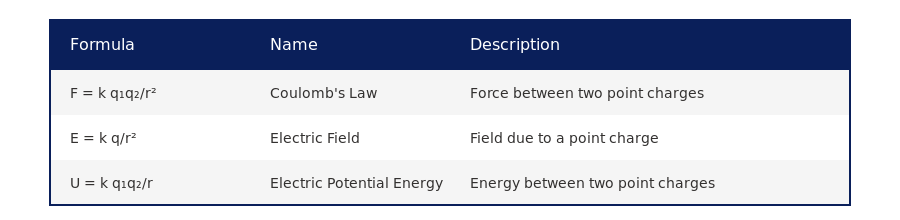 Electrostatics formula table[/caption]
Application of Coulomb’s Law
Coulomb’s law helps determine the force between two charged particles, such as in atomic physics and electrostatic equilibrium problems.
For more AP Physics concepts and problem-solving techniques, visit our AP Physics blog.
Electrostatics formula table[/caption]
Application of Coulomb’s Law
Coulomb’s law helps determine the force between two charged particles, such as in atomic physics and electrostatic equilibrium problems.
For more AP Physics concepts and problem-solving techniques, visit our AP Physics blog.
Electrostatics formula table[/caption]
Application of Coulomb’s Law
Coulomb’s law helps determine the force between two charged particles, such as in atomic physics and electrostatic equilibrium problems.
For more AP Physics concepts and problem-solving techniques, visit our AP Physics blog.
AP Physics C Electricity and Magnetism: Gauss’s Law and Electric Fields
Gauss’s Law is a powerful tool for calculating electric fields when there is symmetry.Gauss’s Law Formula
Where:- = Differential area element
- = Charge enclosed
- = Permittivity of free space
Common Applications
- Spherical Symmetry: Electric field outside a charged sphere
- Cylindrical Symmetry: Electric field due to an infinite charged wire
- Planar Symmetry: Field near an infinite charged plane
Electric Potential and Capacitance
Electric potential is the work done per unit charge in moving a charge in an electric field.
[caption id="attachment_538" align="aligncenter" width="900"]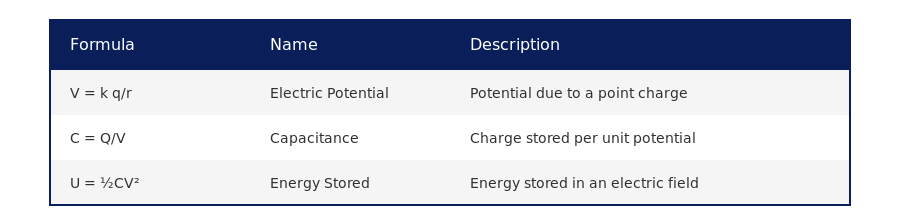 Electric Potential and Capacitance formulas[/caption]
This section covers Ohm’s Law, circuit equations, and power relationships.
Electric Potential and Capacitance formulas[/caption]
Capacitor Applications
Capacitors are widely used in:- Circuit design
- Energy storage (batteries, power backups)
- Filtering signals in electronics

Ohm’s Law
Where:
- = Voltage
- = Current
- = Resistance
Application in Circuits
- Series Circuits: Total resistance is the sum of individual resistances.
- Parallel Circuits: Inverse of total resistance is the sum of individual reciprocals.
Magnetism and Magnetic Fields
Magnetism arises from moving charges and currents. The key equations include:
[caption id="attachment_540" align="alignleft" width="900"]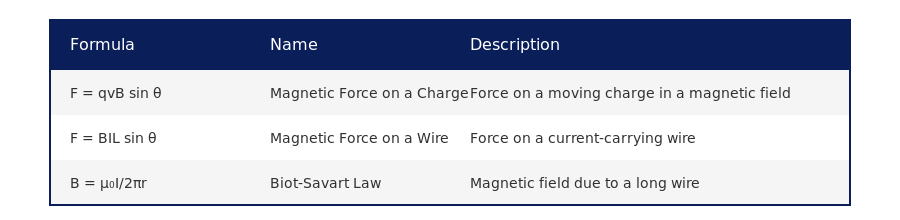 Magnetism and magnetic field formula table[/caption]
Magnetism and magnetic field formula table[/caption]
Applications of Magnetism
- Electric motors
- Magnetic resonance imaging (MRI)
- Electromagnetic levitation
Induction and Electromagnetic Waves
Faraday’s Law and Lenz’s Law describe how changing magnetic fields induce voltage.
[caption id="attachment_546" align="alignleft" width="800"] Faraday's law[/caption]
Faraday's law[/caption]
Faraday’s Law
Where:- = Induced EMF
- = Number of turns
- = Magnetic flux
[caption id="attachment_541" align="aligncenter" width="1024"]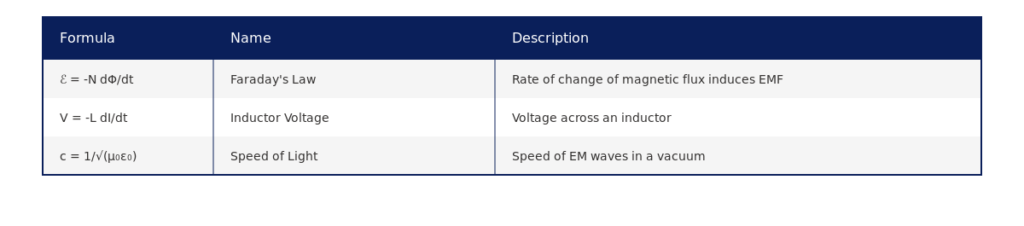 Induction and Electromagnetic Waves formulas[/caption]
Induction and Electromagnetic Waves formulas[/caption]
Applications of Electromagnetic Induction
- Transformers: Step-up and step-down voltage
- Generators: Convert mechanical energy into electricity
- Wireless charging: Uses induction principles
Final Tips for AP Physics C Exam
- Understand concepts before memorizing formulas – Many formulas are derived from fundamental laws.
- Practice problems regularly – Apply formulas to real-world problems.
- Use diagrams and tables – Visualizing problems makes them easier to solve.
- Take advantage of online resources – Visit College Board AP Physics C for official information.