

Should you pay for SAT tutoring, or can you get the same results with SAT self-study? It is one of the most common questions families face during the college prep process, and the honest answer is: it depends on your situation.
Some students improve 200+ points through disciplined self-study with free resources. Others spend months studying on their own and see little progress, only to break through within weeks of starting with a tutor. The difference is not intelligence or effort. It is about matching the right approach to your specific needs.
This guide provides an honest comparison of SAT tutoring vs self-study, including cost, effectiveness, time investment, and the types of students who benefit most from each approach. By the end, you will know exactly which path gives you the best chance of reaching your target score.
The SAT Tutoring vs Self-Study Debate: Why It Matters
The decision between tutoring and self-study is fundamentally about efficiency. Both approaches can produce excellent results, but they work through different mechanisms and suit different student profiles.
Self-study relies on your ability to diagnose your own weaknesses, find the right resources, create and follow a study plan, and hold yourself accountable. It is free or low-cost and gives you complete flexibility over your schedule.
Tutoring relies on an expert who can diagnose your weaknesses faster and more accurately than you can, provide strategies tailored to your specific error patterns, and hold you accountable to a plan. It costs more money but typically saves time and produces faster results.
Neither approach is universally better. The right choice depends on your starting score, your target score, your self-discipline, your timeline, and your budget.
SAT Self-Study: When It Works and When It Falls Short
When Self-Study Works Well
- You are naturally self-disciplined. You can create a study schedule and follow it consistently without external accountability.
- Your content gaps are clear. You know exactly which math topics or reading question types you struggle with and can find resources that address them.
- You are starting below 1200. At lower starting scores, there are significant foundational skills to build, and much of this work can be done effectively through self-study with good materials.
- You are good at self-assessment. You can honestly evaluate why you got a question wrong and develop strategies to avoid the same mistake.
- Your budget is limited. Free resources like Khan Academy and the College Board Bluebook app are genuinely excellent and sufficient for many students.
When Self-Study Falls Short
- You do not know what you do not know. Self-study requires you to diagnose your own weaknesses, which is inherently difficult. You may spend weeks studying the wrong topics.
- Your score has plateaued. If you have been studying consistently but your practice test scores have stopped improving, you likely need an outside perspective to identify what is blocking your progress.
- You struggle with accountability. Without someone checking your progress and adjusting your plan, it is easy to skip sessions, avoid hard topics, and lose momentum.
- You are aiming above 1400. The higher your target score, the more personalized your prep needs to be. The difference between a 1350 and a 1500 often comes down to subtle error patterns that are hard to identify on your own.
SAT Tutoring: Benefits, Costs, and What to Look For
Key Benefits of SAT Tutoring
- Expert diagnosis. A good tutor can analyze your diagnostic test and identify weaknesses, error patterns, and strategic gaps that you would miss on your own.
- Customized study plan. Instead of following a generic curriculum, a tutor builds a plan specifically for your score level, target, timeline, and weaknesses.
- Real-time feedback. When you make a mistake, a tutor can explain what went wrong and teach you the correct approach immediately, rather than you discovering the error days later during a review.
- Accountability. Regular tutoring sessions create a structure that keeps you on track. Knowing you have a session coming up motivates you to complete your practice assignments.
- Strategy coaching. Beyond content, a tutor teaches test-taking strategies specific to your needs: pacing, elimination, flagging, and managing test anxiety.
SAT Tutoring Cost Comparison
| Tutoring Type | Cost per Hour | Typical Total Cost | Best For |
|---|---|---|---|
| Online Private Tutor | $50 to $150 | $800 to $3,000 | Personalized prep, flexible scheduling |
| In-Person Private Tutor | $75 to $200 | $1,200 to $5,000 | Students who prefer face-to-face learning |
| Small Group Tutoring | $30 to $75 | $500 to $1,500 | Social learners, budget-conscious families |
| Online Course (self-paced) | N/A (flat fee) | $100 to $500 | Structured learners with moderate budgets |
| Self-Study (books and free resources) | N/A | $0 to $80 | Disciplined students with clear weaknesses |
What to Look for in an SAT Tutor
- Starts with a diagnostic assessment before creating a study plan.
- Has specific experience with the current digital SAT format.
- Can explain concepts at your level, not just demonstrate mastery of their own.
- Tracks your progress with data: practice test scores, error rates by topic, and improvement trends.
- Adjusts the plan based on your ongoing performance, not following a rigid script.
- Communicates progress to parents (for high school students) regularly.
Head-to-Head Comparison: SAT Tutoring vs Self-Study Results
| Factor | Self-Study | Tutoring |
|---|---|---|
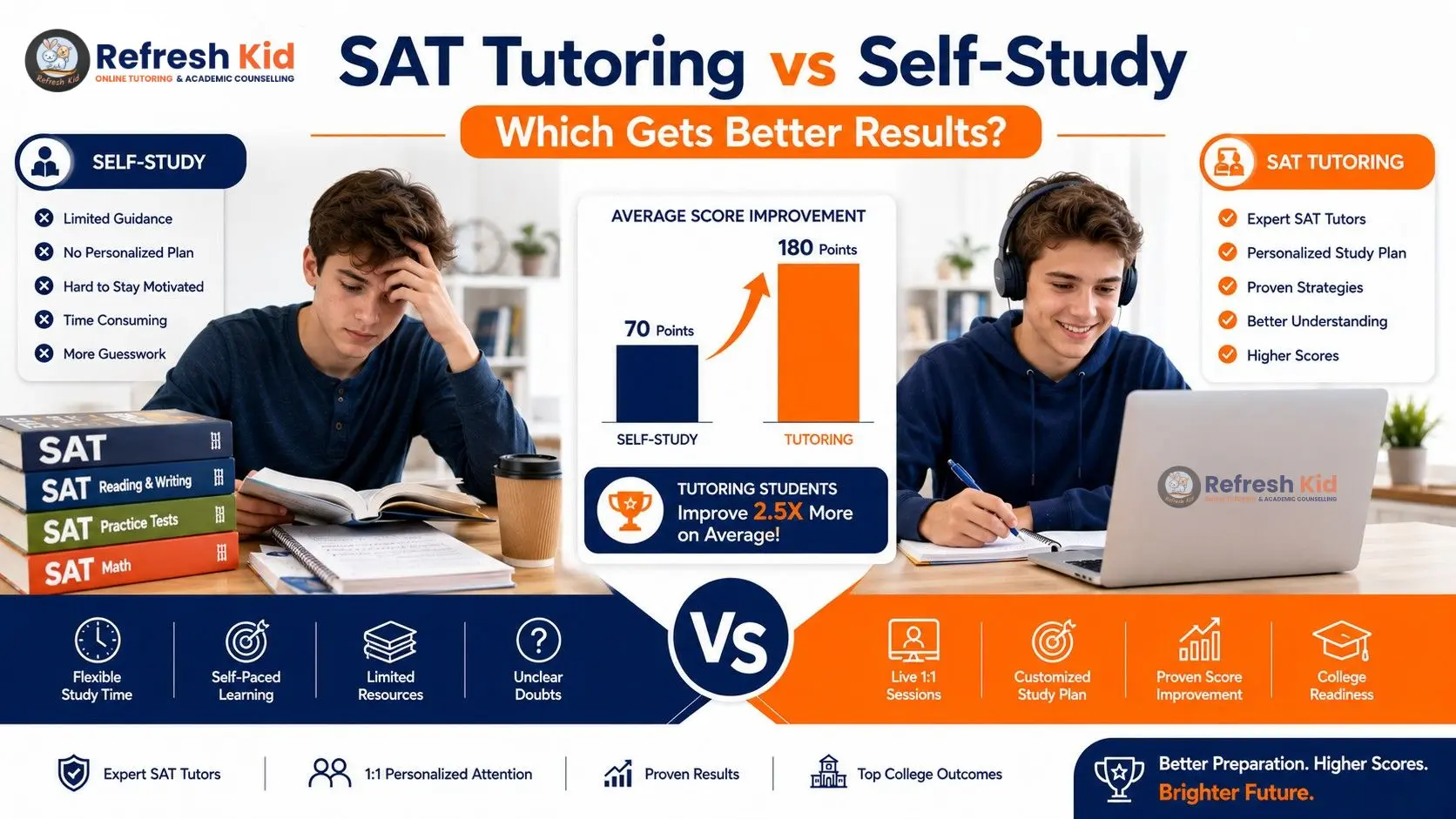
| Typical Score Improvement | 50 to 150 points | 100 to 250 points |
| Time to See Results | 2 to 6 months | 1 to 4 months |
| Cost | $0 to $80 | $500 to $5,000 |
| Personalization | Low (you diagnose yourself) | High (expert diagnosis) |
| Accountability | Self-managed | Built into the program |
| Flexibility | Maximum (study any time) | Moderate (scheduled sessions) |
| Best for Starting Below 1200 | Effective with good materials | Effective but may not be cost-necessary |
| Best for Targeting Above 1400 | Difficult without expert feedback | Highly effective |
The Hybrid Approach: The Best of Both Worlds
For many students, the most effective approach is a combination of self-study and tutoring. This hybrid model gives you the personalized diagnosis and accountability of a tutor while keeping costs manageable.
How the Hybrid Model Works
- Start with a diagnostic session with a tutor. The tutor analyzes your strengths, weaknesses, and error patterns, then builds a personalized study plan.
- Complete daily self-study using the tutor's plan. You work through practice problems, review content, and maintain your error log independently.
- Meet with your tutor weekly or biweekly. During sessions, the tutor reviews your progress, addresses questions you could not solve on your own, adjusts your plan based on new practice test data, and teaches strategies for your most persistent weaknesses.
- Take practice tests independently and review with your tutor. You take the test alone under real conditions, then your tutor helps you analyze the results and extract maximum learning from each wrong answer.
This approach typically costs 40 to 60 percent less than full-time tutoring while producing comparable results for most students.
Common Mistakes When Choosing Your SAT Prep Approach
- Choosing based on cost alone. The cheapest option is not always the best value. If three months of self-study produce 80 points of improvement but one month with a tutor produces 120, the tutor may actually be more cost-effective per point gained.
- Assuming all tutors are the same. Tutor quality varies enormously. A college student who scored well on the SAT is not the same as an experienced professional SAT tutor with a track record of results. Always ask about the tutor's approach, experience, and student outcomes.
- Buying a tutoring package without a diagnostic first. Any tutor who starts teaching without first assessing your specific weaknesses is following a generic plan that may not address your actual needs. Always start with a diagnostic.
- Giving up on self-study too quickly. If you have only been self-studying for two weeks and your practice test score has not changed, that is normal. Self-study takes time. Give it at least 4 to 6 weeks of consistent effort before concluding it is not working.
- Sticking with self-study too long when it is not working. On the other hand, if you have been self-studying for 2 to 3 months with no improvement, continuing the same approach is unlikely to produce different results. It may be time for expert help.
- Ignoring the student's preference. Some students thrive with the independence of self-study. Others need the structure and interaction of tutoring. Match the approach to the student, not the other way around.
Pro Tips for Getting the Best Results from Any SAT Prep Method
- Always start with a diagnostic test. Regardless of whether you choose self-study, tutoring, or a hybrid approach, a diagnostic test is the foundation of effective preparation.
- Maintain an error log no matter what. Whether you study alone or with a tutor, tracking your mistakes is the single most effective tool for targeted improvement.
- Use official College Board materials for practice tests. Third-party questions are useful for content drill, but your practice tests should always be from the official source. This ensures your score predictions are accurate.
- Commit to consistency over intensity. Studying 1.5 hours every day for 3 months beats studying 6 hours a day for 3 weeks. Consistent practice builds lasting skills and habits.
- Evaluate your progress every 3 to 4 weeks. Take a practice test monthly and compare it to your baseline. If you are not seeing improvement, change your approach before more time is wasted.
- Do not be afraid to switch approaches midstream. If self-study is not producing results after 6 to 8 weeks, try adding tutoring. If your tutor is not a good fit, find a new one. The sunk cost fallacy wastes more SAT prep time than any other mistake.
Frequently Asked Questions About SAT Tutoring vs Self-Study
Is SAT tutoring worth the money?
SAT tutoring is worth the money for students who have specific weaknesses they cannot diagnose on their own, who have plateaued with self-study, or who are targeting top-tier schools where every point matters. The value depends on the quality of the tutor. A good tutor who customizes your plan based on a diagnostic assessment will produce better results than a tutor who follows a generic curriculum. On average, students who work with a qualified tutor see larger and faster score improvements than self-study students.
Can I get a good SAT score without a tutor?
Yes, many students achieve excellent SAT scores through self-study. The keys to successful self-study are discipline, high-quality materials, a structured study plan, and honest self-assessment. Students who use official College Board practice tests, maintain an error log, and follow a consistent daily study schedule can achieve significant improvements without paid help.
How much does SAT tutoring cost?
SAT tutoring costs range widely. Private in-person tutors typically charge 75 to 200 dollars per hour. Online tutors often charge 50 to 150 dollars per hour. Tutoring packages for a full prep program range from 1000 to 5000 dollars depending on the number of sessions and the tutor's experience. Group tutoring and online courses are less expensive alternatives ranging from 200 to 1000 dollars.
What is the difference between online and in-person SAT tutoring?
Online SAT tutoring uses video calls, shared screens, and digital whiteboards to deliver instruction remotely. In-person tutoring takes place face to face. Both formats can be highly effective. Online tutoring offers more scheduling flexibility, eliminates travel time, and often costs less. In-person tutoring may be better for students who struggle with focus during screen-based learning. The quality of the tutor matters more than the delivery format.
When should I consider getting an SAT tutor?
Consider getting an SAT tutor if your score has plateaued despite consistent self-study, if you cannot identify why you are getting questions wrong, if you are aiming for a score above 1400 and need to close the gap on the hardest questions, or if you have limited time before your test date and need to maximize efficiency. A tutor is also valuable if you struggle with test anxiety or time management.
Find Out Which Prep Approach Is Right for You
The best SAT prep strategy is the one built for your unique starting point, target score, and learning style. At RefreshKid, we start every student relationship with a free diagnostic session that reveals exactly where you stand and what kind of support will produce the best results for you.
Book a Free Diagnostic Session with RefreshKid and discover whether self-study, tutoring, or a hybrid approach is the fastest path to your target score.