

Quick Answer: What Homework Strategies Actually Improve Student Performance?
The homework strategies that actually improve student performance combine a fixed daily routine, active problem-solving instead of passive copying, a system for checking and correcting mistakes, and short, focused work sessions instead of long unfocused ones. Homework only helps when it is done in a way that builds real understanding, not just completion.
For families who want live US-certified teachers, personalized homework coaching, AP and SAT/ACT support, K-12 subject tutoring, and weekly parent reports, Refresh Kid is designed to help students turn homework time into real academic growth.
Key Takeaways for Parents
- Homework only improves performance when it is done actively, not copied or rushed through.
- Many students struggle with homework not because of difficulty, but because of poor time structure and no system for reviewing mistakes.
- Different subjects require different homework strategies. Math homework, reading assignments, and science labs are not the same task.
- Homework habits should evolve as a child moves from elementary school into middle school, high school, and AP or test-prep years.
- Parent involvement should focus on structure and accountability, not doing the work for the child.
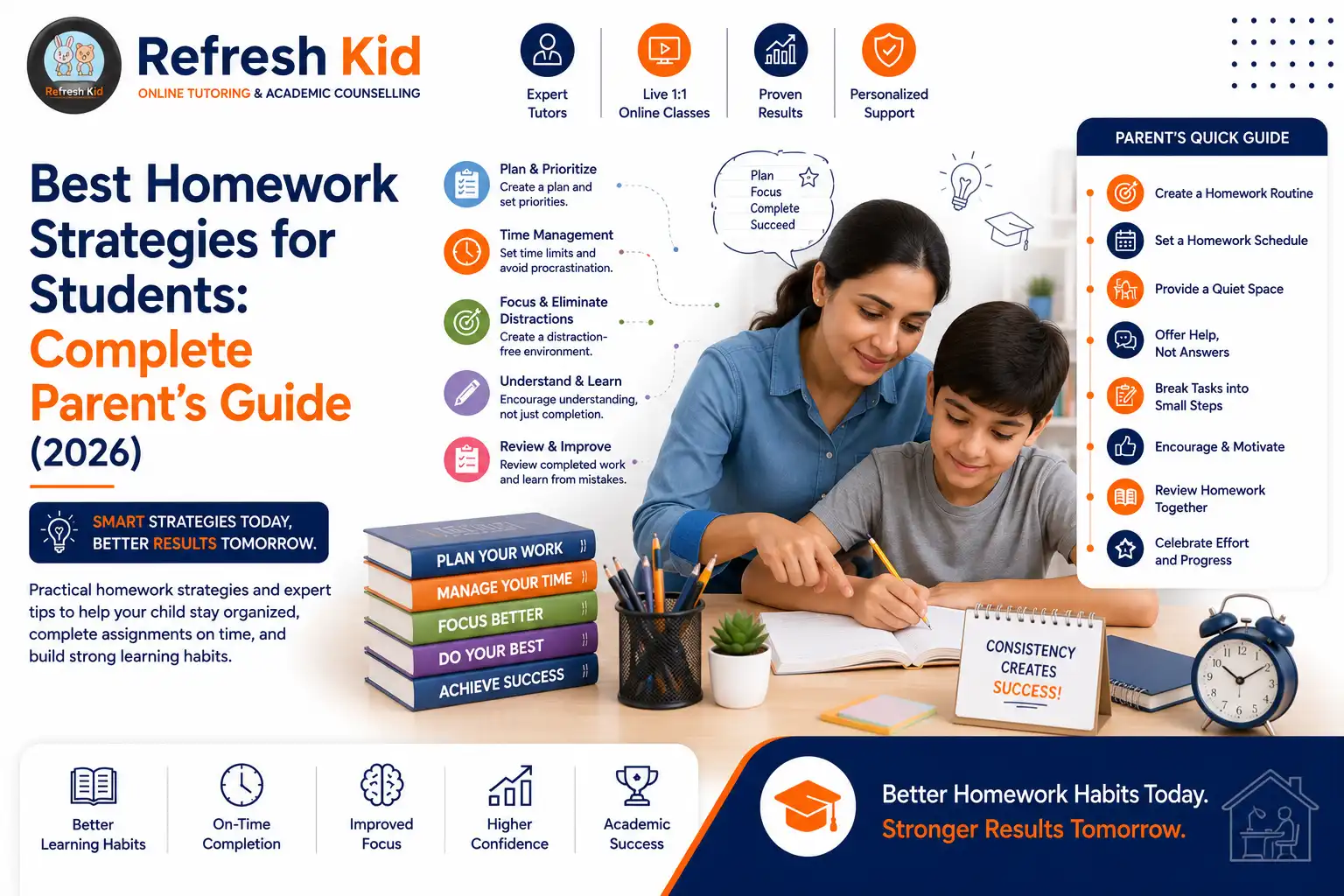
Effective Homework Starts With a Clear System
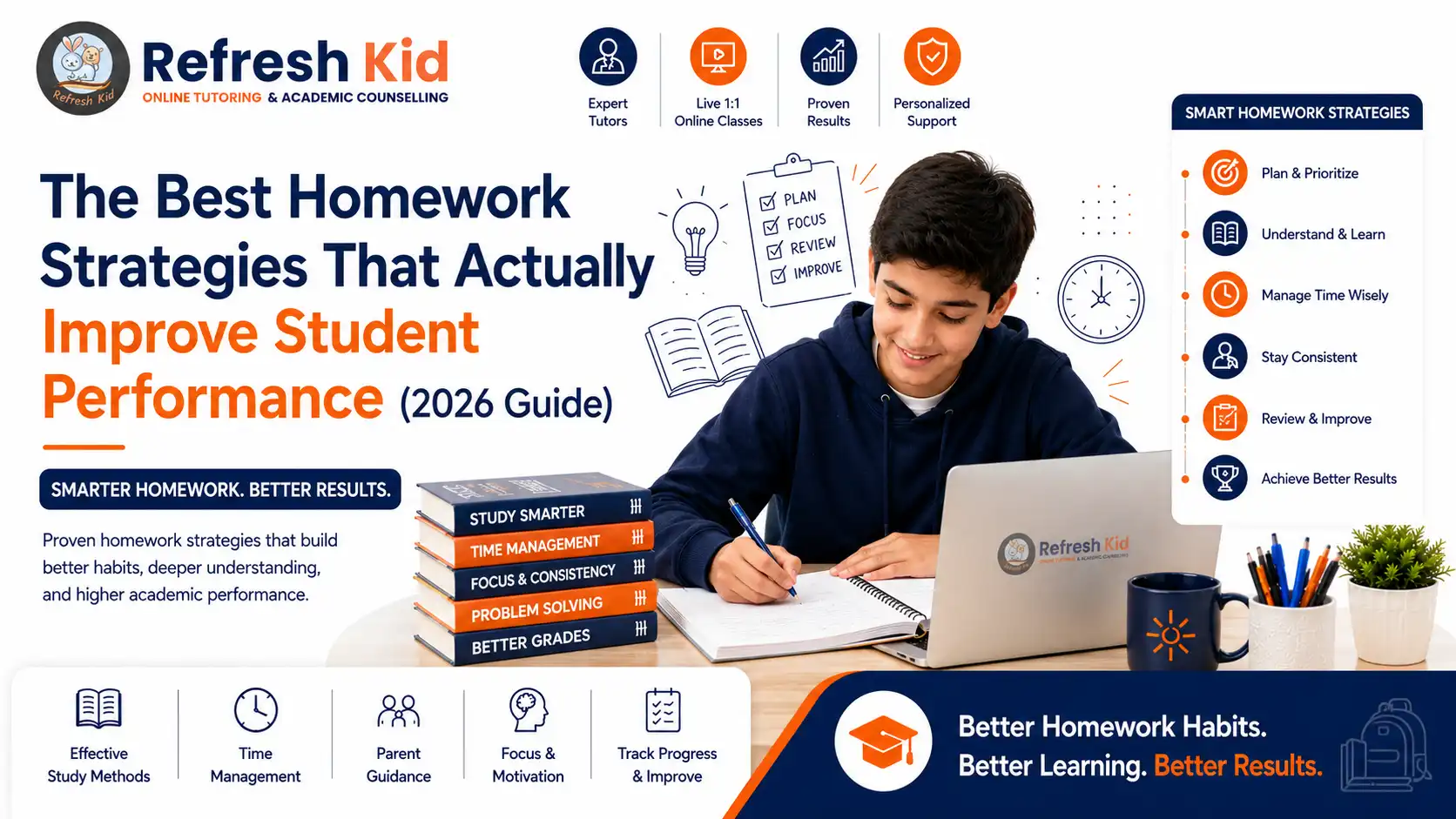
Fixed routine, active problem-solving, mistake review, and short focused sessions that actually build understanding.
Why Most Homework Strategies Fail to Improve Performance
Parents often assume that finishing homework is the same as learning from it. In reality, a child can complete every assignment and still not improve, because homework only builds skill when it is done actively and reviewed carefully. Copying steps from an example, rushing through problems, or skipping the review of wrong answers turns homework into a checklist item instead of a learning tool.
The strategies that actually move the needle focus on how homework is done, not just whether it gets done. A student who spends 20 focused minutes actively working through a few problems and reviewing mistakes will retain more than a student who spends an hour distracted and rushing to finish.
Students Often Need a Better System, Not More Homework Time
In many families, the instinct is to extend homework time when grades slip. But more time without a better process usually leads to frustration instead of improvement. Parents should first ask: is my child actively solving problems, or copying patterns? Is there a way to check whether the homework was actually understood? Is my child reviewing mistakes, or just moving to the next question?
A strong homework strategy helps students answer important questions: Am I solving this the way I would need to on a test? Do I understand why an answer is correct, not just that it is correct? Which parts of this assignment am I rushing through? How do I know if I am ready to move on?
Common Homework Struggles by Age Group
Homework challenges look different depending on a child's age and grade level. A strong parenting article should speak directly to the specific struggles families are facing at each stage.
| Age / Grade Level | Common Struggle | Best Strategy to Build |
|---|---|---|
| Elementary (K-5) | Rushing through worksheets, easily distracted | Short focused sessions, immediate parent check-ins |
| Middle School (6-8) | Copying examples instead of solving independently | Guided practice, explaining answers out loud |
| Early High School (9-10) | Skipping review of wrong answers, procrastination | Mistake logs, scheduled homework blocks by subject |
| AP & Test-Prep Years (11-12) | Treating homework as separate from exam prep | Connecting homework practice to timed test conditions |
| College-Bound Seniors | Inconsistent independent work habits | Self-managed schedules with light accountability check-ins |
Homework Support for Every Age
Refresh Kid supports K-12 students in building active homework habits and subject mastery at every stage.
What an Effective Homework Routine Actually Looks Like
Many families try generic rules like "finish homework before dinner" without a deeper structure. The difference between homework that improves performance and homework that just fills time is whether it includes active practice and review. Parents should look for consistency, active engagement, and a way to catch mistakes.
1. A Predictable Start Time and Space
Homework goes faster and sticks better when it starts at the same time each day, in a quiet space without phones or background screens pulling focus.
2. Solving Before Checking the Answer
Attempting a problem fully before looking at the solution forces real thinking. Checking the answer first and working backward teaches almost nothing.
3. Reviewing Every Wrong Answer
Homework that is graded but never reviewed wastes its biggest benefit. Understanding why an answer was wrong is where the actual learning happens.
4. Matching the Strategy to the Assignment Type
A math worksheet, a reading response, and a lab report all require different approaches. Using one generic homework method across every subject slows progress.
Subject-Specific Homework Strategies That Actually Work
One of the biggest mistakes parents make is treating all homework the same way. A child who "does" math homework by copying the example format is not actually practicing the reasoning that will be tested. Each subject rewards a different kind of homework approach.
Building the right homework strategy for each subject early prevents frustration later, especially once assignments become longer and more demanding in middle and high school.
| Subject | Why Generic Homework Habits Fail | Best Homework Strategy |
|---|---|---|
| Math | Copying the worked example skips the actual problem-solving step | Attempt independently first, then check and review errors |
| Reading / ELA | Skimming for answers misses comprehension | Summarize each section, answer in full sentences |
| Science | Filling in worksheet blanks without explaining the reasoning | Explain the "why" behind each answer out loud or in writing |
| Writing | Turning in a first draft without revision | Draft, self-review, then revise before submitting |
| Test Prep (SAT/ACT/AP) | Treating homework as separate from timed exam practice | Complete practice sets under light time pressure |
Homework Strategy by Subject
The right approach changes depending on what is being practiced and how it will eventually be tested.
Math
Independent attempt first, then review every error.
Reading
Summarizing and full-sentence responses.
Science
Explaining reasoning, not just filling blanks.
Writing
Draft, self-review, and revise before submitting.
Test Prep
Practice sets under light time pressure.
Organization
Assignment tracking and weekly review sessions.
Focus and Time Management Strategies That Boost Homework Results
Homework performance is not only about technique. Focus and time management determine whether a good strategy is actually applied consistently. Students who work in short, timed bursts with clear breaks tend to retain more than students who sit for long, unstructured stretches.
The students who improve the most usually break homework into manageable blocks, set a clear stopping point for each subject, and avoid multitasking with phones or other screens during work time.
| Grade | Recommended Session Length | Focus Strategy |
|---|---|---|
| Elementary (K-5) | 10 to 20 minutes per subject | Short bursts with a clear start and stop time |
| Middle School (6-8) | 20 to 30 minutes per subject | Phone in another room, one subject at a time |
| High School (9-12) | 30 to 45 minutes per subject | Scheduled blocks with a 5 to 10 minute break between |
| AP & Test-Prep Years | 45 to 60 minutes for practice sets | Timed practice blocks that mirror real exam pacing |
Grade-by-Grade Homework Skills Roadmap
Homework strategies should evolve as a child grows. A method that works for a third grader will not serve a junior preparing for AP exams. Building the right habits at the right stage prevents students from having to relearn how to approach assignments under pressure later.
For students aiming at strong academic outcomes, the foundation begins earlier than many families realize. Independent problem-solving, review habits, and time management built in elementary and middle school directly affect how easily a student adapts to AP-level workloads and standardized testing later on.
Homework Skills Roadmap by Stage
- Elementary school: Build a predictable start time, short focused sessions, and immediate parent check-ins.
- Middle school: Introduce independent problem-solving before checking answers and explaining reasoning out loud.
- Early high school: Develop mistake logs, scheduled subject blocks, and consistent review habits.
- Junior year: Connect homework practice directly to timed, exam-style conditions.
- Senior year: Shift toward self-managed schedules with light accountability check-ins.
Homework Skills Growth Roadmap
From short guided sessions through independent, exam-ready homework habits.
Elementary
Predictable start time and short focused sessions.
Middle School
Independent problem-solving and explaining reasoning.
Early High School
Mistake logs and scheduled subject blocks.
Junior Year
Homework connected to timed exam conditions.
Senior Year
Self-managed schedules and light check-ins.
Independent Homework vs. Guided Support
Independent homework works well once a student has already built strong habits: attempting problems before checking answers, reviewing mistakes, and managing time well. But for students still developing these habits, unguided homework time often leads to rushed answers, copied work, and repeated mistakes. For busy families, guided support can build the right process faster.
| Factor | Guided Homework Support | Unguided Independent Homework |
|---|---|---|
| Accountability | Built-in through regular sessions | Depends entirely on the student |
| Feedback on mistakes | Immediate, expert-guided | Often delayed or missed entirely |
| Active problem-solving habit | Modeled and reinforced by a teacher | Easy to slip into copying or guessing |
| Parent visibility | Weekly reports and check-ins | Varies, often unclear |
| Subject-specific technique | Taught explicitly by a teacher | Often generic across all subjects |
Parent Checklist: Improving Homework Results at Home
Routine
- Is there a predictable time and place for homework each day?
- Are phones and other distractions removed during homework time?
- Are sessions broken into focused blocks by subject?
Technique
- Is the child attempting problems before checking the answer?
- Does the approach match the type of assignment?
- Is the child explaining answers instead of just writing them?
Feedback
- Does the child review every wrong answer, not just the score?
- Is there a weekly check-in on which assignments were hardest?
- Can the child explain why an answer was incorrect?
Long-Term Growth
- Does the homework strategy evolve as the child moves up in grade level?
- Is homework practice connected to upcoming tests or AP exams?
- Is the child gradually taking more ownership of the homework process?
Why Families Choose Refresh Kid to Improve Homework Performance
Refresh Kid supports K-12 students online with a structure that turns homework time into real academic progress. Instead of guessing which strategy will work, families get a plan built around the student's grade level, subjects, and goals, guided by a live teacher who tracks progress every week.
Live US-Certified Teachers
Students work with real teachers who model active problem-solving and correct copying habits early.
Weekly Parent Reports
Parents receive clear updates on what was practiced, which habits improved, and what still needs attention.
Subject-Specific Coaching
Refresh Kid tailors homework strategy to each subject, from math problem sets to reading response and essay revision.
Test-Prep Homework Systems
Students connect everyday homework practice to timed-exam habits well before SAT, ACT, or AP exam season begins.
K-12 Coverage
Families can build homework routines for elementary foundations, middle school organization, and high school independence in one place.
3,000+ Students Served
Refresh Kid has supported thousands of students with over 900,000 learning hours across K-12 subjects.
Frequently Asked Questions
The most effective strategies combine a fixed daily routine, attempting problems independently before checking answers, reviewing every mistake, and working in short, focused sessions rather than long distracted ones. Simply finishing homework does not improve performance unless it is done actively.
This usually happens when homework is completed passively, such as copying examples or rushing through answers without reviewing mistakes. Homework only builds test-ready skills when a student solves problems independently and understands why each answer is right or wrong.
Elementary students generally benefit from 10 to 20 minute sessions per subject, middle schoolers from 20 to 30 minutes, and high schoolers from 30 to 45 minutes with short breaks in between. Longer, unfocused sessions tend to produce diminishing returns.
Parents should focus on structure and accountability rather than correcting every answer themselves. Asking the child to explain their reasoning, rather than pointing out mistakes directly, builds stronger long-term understanding and independence.
Yes. Refresh Kid teachers model active problem-solving during sessions, including independent attempts before checking answers, mistake review, and subject-specific strategies, so students build lasting homework habits alongside subject mastery.
Absolutely. Strong students often use better homework systems to prepare for AP exams, improve SAT/ACT scores, and manage a heavier course load without burning out. Effective homework habits are not only for students who are struggling.
Require the child to attempt every problem independently before checking any example or answer key. Asking them to explain their reasoning out loud after finishing also makes copying much harder to sustain and reinforces genuine understanding.
The most common mistake is giving the child the correct answer too quickly instead of guiding them to find it. This removes the productive struggle that actually builds understanding and makes the child dependent on being told the answer.
Ask whether the tutor teaches active problem-solving rather than giving answers directly, whether progress is reported weekly, whether the approach is customized by subject, and whether the strategy evolves as the student moves up in grade level.
Families can visit www.refreshkid.com to request a free demo class or academic assessment for their child.
Ready to Turn Homework Time Into Real Progress?
Whether your child needs a stronger routine, subject-specific strategy, or a structured test-prep plan, Refresh Kid helps families improve homework performance with live US-certified teachers and clear weekly parent communication.