

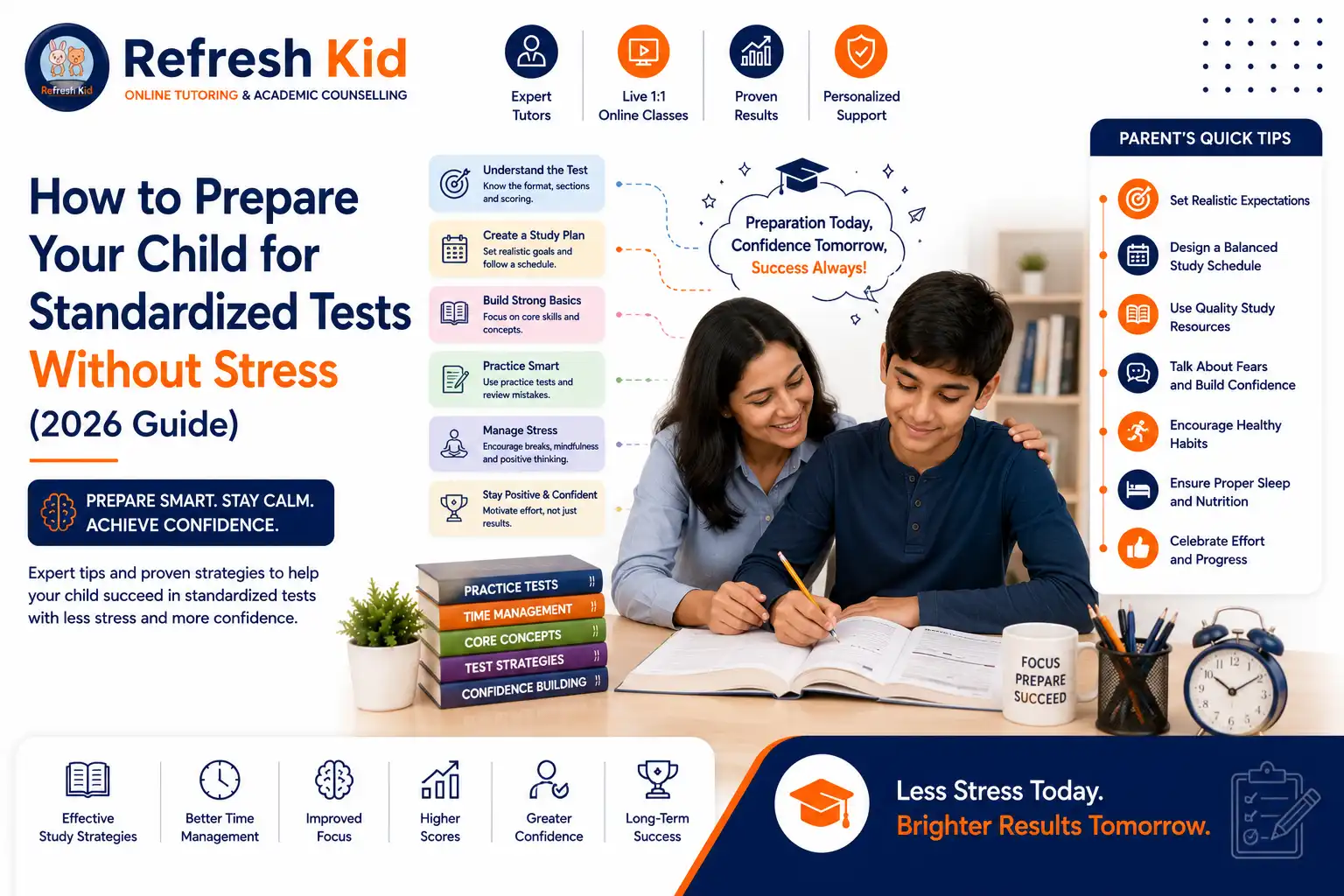
Quick Answer: How Can I Prepare My Child for Standardized Tests Without Stress in 2026?
Students prepare for standardized tests without unnecessary stress by starting well ahead of the exam date, building a realistic study plan around known weak spots, taking regular timed mock tests instead of only reviewing content, and treating test anxiety as a skill to manage rather than something to push through. Confidence comes from familiarity with the test format, not from cramming in the final weeks.
For families who want live US-certified teachers, personalized readiness assessments, dedicated SAT/ACT and AP test prep, K-12 subject tutoring, and weekly parent reports, Refresh Kid is designed to help students build test prep plans that reduce stress and improve scores.
Key Takeaways for Parents
- Good test prep depends on an early, structured plan, not a few intense weeks of cramming before the exam.
- Many students feel test anxiety not because of the material itself, but because of unfamiliarity with the test's format and pacing.
- Different stages need different test prep priorities. A student taking their first standardized test and a junior prepping for the SAT are not facing the same pressure.
- Test prep strategies should evolve as a child moves from early state testing into PSAT, SAT, ACT, and AP exams.
- Parent involvement should focus on structure and encouragement, not added pressure in the weeks before the exam.
Confidence Comes From Familiarity, Not Cramming
Early planning, realistic study blocks, regular mock tests, and stress-management techniques turn test day into something familiar instead of frightening.
Why Most Test Prep Plans Fail to Reduce Anxiety
Parents often assume that a few weeks of intense review right before the exam is enough to prepare a child. In reality, a student can review every topic on the test and still feel anxious walking in, because the real source of stress is usually unfamiliarity with pacing and format, not missing content knowledge. Starting prep only when the exam date feels close, skipping timed practice, or ignoring the specific sections that cause the most trouble turns test prep into a source of panic instead of confidence.
The strategies that actually reduce exam stress focus on building familiarity over time, not cramming content in a short window. A student who takes a full-length timed mock test a month before the exam will walk in calmer than a student who has only studied content in isolation.
Students Often Need a Plan, Not Just More Practice Problems
In many families, the instinct is to hand a child a stack of practice books and hope for the best. But adding more problems without a structured plan usually leads to uneven preparation, strong in some areas and weak in others. Parents should first ask: does my child know their specific weak sections, or are they studying everything equally? Have they taken a full-length timed practice test recently, or only studied in short, untimed bursts? Do they have strategies for managing nerves on test day itself?
A strong test prep plan helps families answer important questions: Is my child using a plan built around their actual score gaps, or just working through generic material? Do they understand the format and timing of the test, or are they discovering it for the first time on exam day? Which section, math, reading, or writing, needs the most attention right now? How do we know if the current prep is actually working?
Common Test Prep Struggles by Stage
Standardized test prep challenges look different depending on a child's grade level and which exam is coming up. A strong parenting article should speak directly to the specific struggles families are facing at each stage.
| Stage | Common Struggle | Best Strategy to Build |
|---|---|---|
| Elementary State Testing | Unfamiliar with test format causes nervousness, not lack of knowledge | Simple practice tests to build comfort with format and timing |
| Middle School Testing | Struggles to pace through longer sections without rushing or stalling | Timed section practice, basic pacing strategies |
| PSAT & Early SAT/ACT Prep | No baseline understanding of current score or weak sections | Diagnostic test, targeted review of weakest section first |
| SAT & ACT Test Years | Underestimating how much timed, full-length practice is needed | Regular full-length mock tests, review of missed question patterns |
| AP Exam Season | Balancing multiple AP subjects with different exam formats | Subject-by-subject pacing calendar starting months in advance |
Test Prep Support for Every Stage
Refresh Kid supports K-12 students in building test-taking confidence and skills that lead to real score improvement.
What an Effective Test Prep Plan Actually Looks Like
Many families try generic advice like "study more" without a deeper plan. The difference between test prep that actually reduces stress and test prep that just fills a calendar is whether it includes realistic timed practice and an honest look at which sections need the most work. Parents should look for consistency, the right pacing, and a way to catch a weak section before it becomes a source of panic close to the exam.
1. Starting With a Diagnostic Test
Taking a full-length practice test before building a study plan reveals exactly which sections need the most attention, rather than guessing.
2. Regular Timed Mock Tests
Practicing under real timing conditions builds the pacing skills and stamina that untimed review alone can't provide.
3. Targeted Review of Weak Sections
Focusing extra time on the specific question types a student misses most is far more effective than reviewing everything equally.
4. Matching the Plan to the Exam Timeline
A student with six months before the SAT and a student with three weeks before an AP exam need very different pacing plans.
Section-Specific Test Prep Strategies That Actually Work
One of the biggest mistakes parents make is treating every test section the same way. A student who studies math, reading, and writing with the same approach is not accounting for what actually requires a different kind of practice. Each section rewards a different kind of preparation.
Building the right strategy for each section early prevents score plateaus later, especially once test dates get closer and time for practice shrinks.
| Test Section | Why Generic Studying Fails | Best Prep Strategy |
|---|---|---|
| Math | Reviewing formulas without timed practice leaves pacing weak | Timed problem sets that mirror the real section length |
| Reading | Reading passages slowly without practicing under time pressure | Practice skimming for structure first, then answering under timing |
| Writing / Grammar | Memorizing rules without applying them to full passages | Practice full passages instead of isolated grammar questions |
| Essay (where applicable) | Writing practice essays without ever timing them | Practice full essays within the actual time limit |
| Test Anxiety | Ignoring nerves until they surface on test day | Practice under test-like conditions to build familiarity and calm |
Prep Strategy by Section
The right approach changes depending on the section and what's holding the score back.
Math
Timed problem sets that mirror real pacing.
Reading
Skimming for structure, then timed practice.
Writing
Full passages instead of isolated grammar drills.
Essay
Full practice essays within the real time limit.
Test Anxiety
Familiarity through test-like practice conditions.
Mock Tests
Full-length, timed practice on a regular schedule.
Mock Tests and Reducing Exam Stress
Reducing test day stress is not only about how much content is reviewed. Regular mock tests and how study time is structured determine whether a student walks in confident or anxious. Students who practice under real timing conditions tend to feel calmer than students who only review material in an untimed, relaxed setting.
The students who feel least anxious on test day usually take full-length mock tests on a regular schedule, review missed questions by pattern rather than one at a time, and practice basic stress-management techniques like pacing their breathing during timed sections.
| Stage | Recommended Mock Test Frequency | Stress-Reduction Strategy |
|---|---|---|
| Elementary State Testing | One or two short practice tests before the exam | Familiarize with format in a low-pressure, encouraging setting |
| Middle School Testing | A timed practice section every few weeks | Basic pacing strategies and calm review of mistakes |
| PSAT & Early SAT/ACT Prep | One full-length diagnostic, then monthly timed sections | Baseline score review without pressure to improve immediately |
| SAT & ACT Test Years | A full-length mock test every two to three weeks | Reviewing missed question patterns, not just correct answers |
| AP Exam Season | Full-length practice exams for each AP subject in the final month | Subject-by-subject pacing to avoid last-minute overload |
Grade-by-Grade Test Prep Roadmap
Test prep strategies should evolve as a child grows. A simple practice test that works for elementary state testing will not serve a junior preparing for the SAT. Building the right structure at the right stage prevents students from facing high-stakes exams without ever having built real test-taking skills.
For students aiming at strong test outcomes, the foundation begins earlier than many families realize. Familiarity with timing, format, and calm test-taking habits built in earlier grades directly affect how a student handles the pressure of the SAT, ACT, and AP exams later on.
Test Prep Roadmap by Stage
- Elementary school: Build basic familiarity with test format through simple, low-pressure practice tests.
- Middle school: Introduce timed section practice and basic pacing strategies.
- Freshman & sophomore year: Take an early PSAT or baseline diagnostic to identify strengths and weak spots.
- Junior year: Build a structured SAT or ACT prep schedule with regular full-length mock tests.
- Junior & senior year: Layer in AP exam pacing calendars alongside SAT or ACT prep as needed.
Test Prep Growth Roadmap
From basic format familiarity through confident, exam-ready pacing.
Elementary
Low-pressure practice with test formats.
Middle School
Timed section practice and basic pacing.
Early High School
Baseline PSAT or diagnostic testing.
Junior Year
Structured SAT/ACT prep with mock tests.
AP Years
Subject-specific AP exam pacing calendars.
Independent Prep vs. Guided Support
Independent test prep works well once a student has already built strong habits: timed practice, targeted review, and stress management. But for students still developing these habits, unguided prep often leads to uneven studying, skipped mock tests, and rising anxiety close to exam day. For busy families, guided support can build the right process faster.
| Factor | Guided Test Prep Support | Unguided Independent Prep |
|---|---|---|
| Accountability | Built-in through regular sessions | Depends entirely on the student |
| Identifying weak sections | Immediate, expert-guided diagnostic | Often overlooked until scores plateau |
| Consistent mock test schedule | Modeled and reinforced by a teacher | Easy to put off until close to the exam |
| Parent visibility | Weekly reports and check-ins | Varies, often unclear |
| Section-specific pacing | Taught explicitly by a teacher | Often generic across all sections |
Parent Checklist: Test Prep Without Stress
Planning
- Has a diagnostic or baseline test already been taken?
- Is there a study calendar building up to the exam date?
- Are the weakest sections getting extra attention?
Practice
- Is the student taking full-length mock tests on a regular schedule?
- Are missed questions being reviewed by pattern, not just corrected?
- Is practice happening under real timing conditions?
Stress Management
- Does the student feel familiar with the test's format and timing?
- Is there a calm routine planned for the days right before the exam?
- Is pressure from home focused on encouragement rather than added stress?
Long-Term Confidence
- Does the prep plan evolve as the exam date gets closer?
- Is progress being tracked across practice tests over time?
- Is the student gradually feeling more confident, not more anxious?
Why Families Choose Refresh Kid to Build Better Test Prep Habits
Refresh Kid supports K-12 students online with a structure that turns anxious last-minute cramming into steady, confident preparation. Instead of guessing what to prioritize, families get a plan built around the student's diagnostic results, exam timeline, and goals, guided by a live teacher who tracks progress every week.
Live US-Certified Teachers
Students work with real teachers who identify weak sections and rebuild them with proven test-taking strategies.
Weekly Parent Reports
Parents receive clear updates on mock test scores, which sections improved, and what still needs attention.
Section-Specific Coaching
Refresh Kid tailors test prep to each section, from math pacing to reading strategy and essay timing.
Regular Full-Length Mock Tests
Students build real exam stamina and pacing well before the actual test date.
SAT, ACT & AP Coverage
Families can build prep plans across standardized tests and AP exams in one place.
3,000+ Students Served
Refresh Kid has supported thousands of students with over 900,000 learning hours across K-12 subjects.
Frequently Asked Questions
The most effective approach combines starting early, building a study plan around known weak sections, taking regular full-length timed mock tests, and treating test anxiety as something to manage through familiarity rather than avoid.
This often happens when a student hasn't practiced under real timing conditions. Content knowledge alone doesn't guarantee strong pacing, so regular timed mock tests are essential.
Starting with a baseline diagnostic in freshman or sophomore year gives families a clear head start, though most students benefit from a structured prep schedule beginning six months to a year before the exam.
Regular practice under real test-like conditions builds familiarity, which reduces anxiety more effectively than reassurance alone. A calm, encouraging routine in the days before the exam also helps.
Yes. Refresh Kid teachers assess where a student stands through a diagnostic test, then build a prep plan around weak sections, pacing, and mock test practice for the SAT, ACT, or AP exams.
Absolutely. Even strong students often use targeted mock test review to close small score gaps and build the pacing needed for a top score. Test prep support isn't only for students who are struggling.
A full-length mock test every two to three weeks during active SAT or ACT prep gives enough time to review mistakes and adjust the study plan without causing burnout.
The most common mistake is waiting until close to the exam date to start a structured plan. Beginning months in advance with regular timed practice makes the process far calmer than last-minute cramming.
Ask whether the tutor starts with a diagnostic test rather than guessing, whether progress is reported weekly, whether the plan is customized by section and score goal, and whether mock tests are part of the regular schedule.
Families can visit www.refreshkid.com to request a free demo class or academic assessment for their child.
Ready to Build a Test Prep Plan That Actually Reduces Stress?
Whether your child needs a diagnostic assessment, a structured mock test schedule, or targeted section review, Refresh Kid helps families succeed with live US-certified teachers and clear weekly parent communication.