

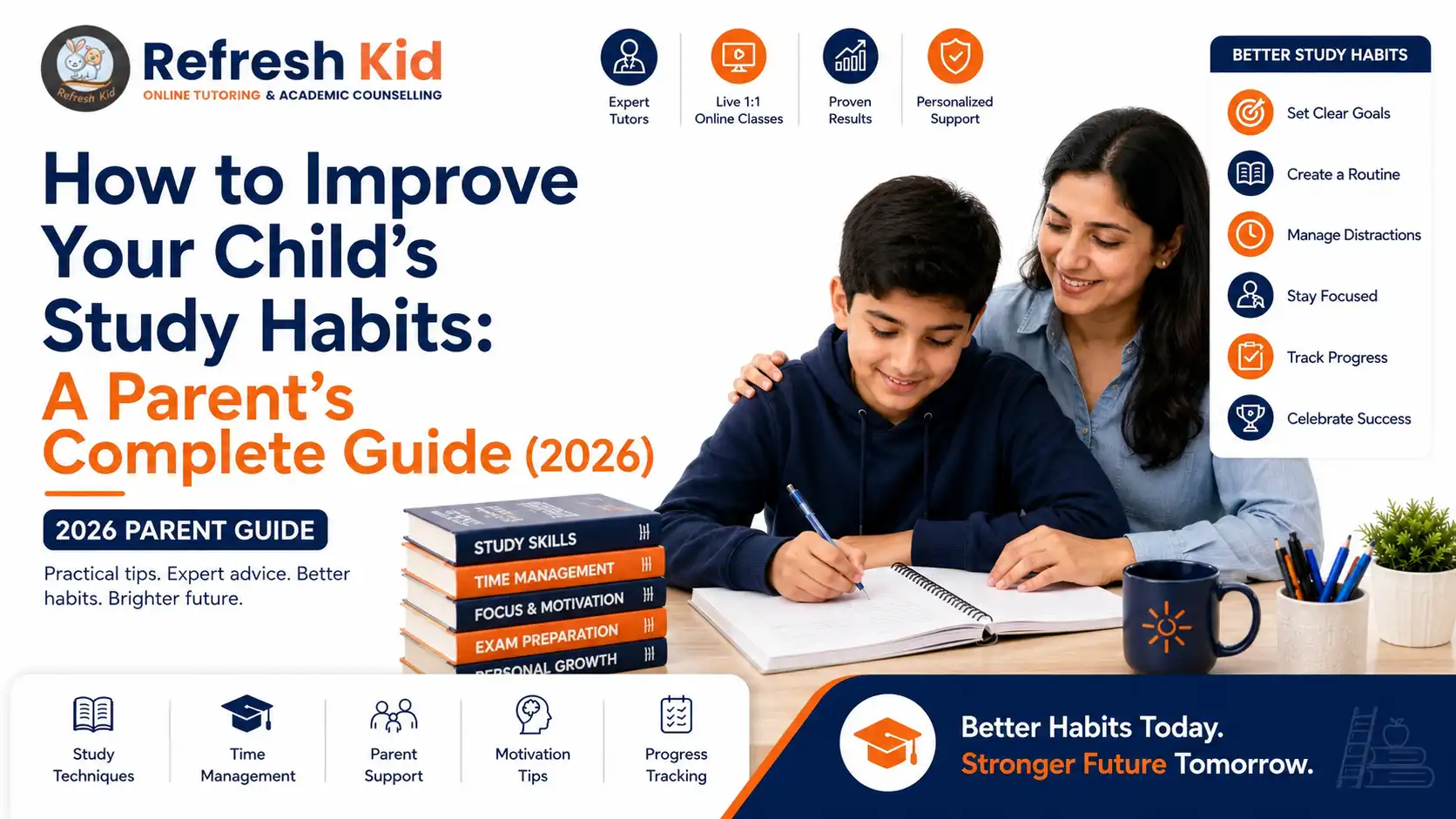
Quick Answer: How Can Parents Help Improve a Child's Study Habits?
The fastest way to improve a child's study habits is to build a consistent routine that includes a fixed study time, a distraction-free space, clear short-term goals, and regular feedback on progress. Children rarely lack the ability to focus. They usually lack structure, and structure is something parents and tutors can build together with the right plan.
For families who want live US-certified teachers, personalized study coaching, AP and SAT/ACT support, K-12 subject tutoring, and weekly parent reports, Refresh Kid is designed to help children build lasting study habits alongside real academic progress.
Key Takeaways for Parents
- Study habits are built through repetition and structure, not motivation alone.
- Many students struggle not because they lack intelligence, but because they lack a system for organizing time and material.
- Different subjects require different study strategies. Math, reading, and science do not benefit from the same technique.
- Study skills should evolve as a child moves from elementary school into middle school, high school, and AP or test-prep years.
- Parent involvement matters most in the early stages of habit-building, then should shift toward light monitoring and encouragement.
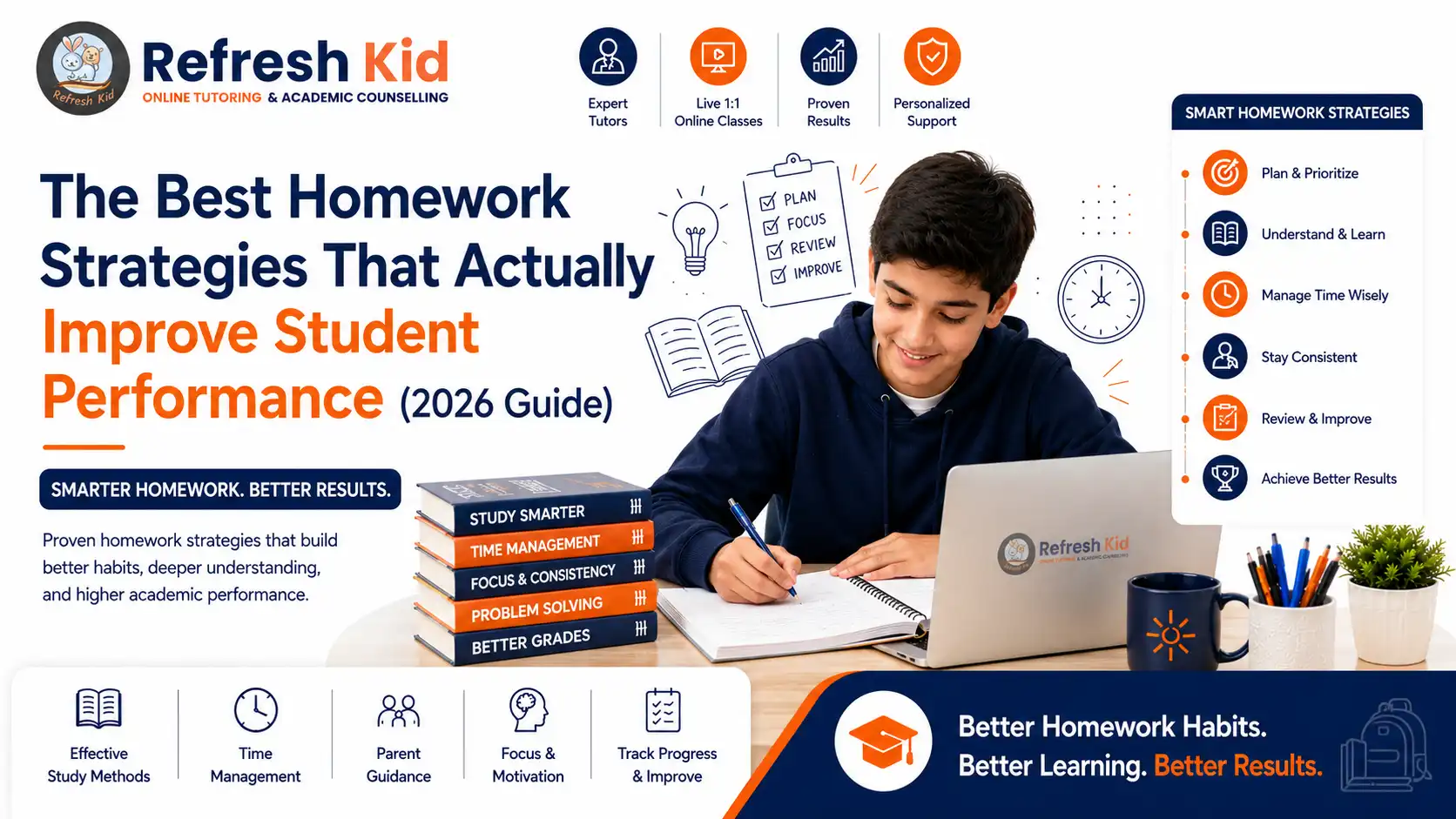
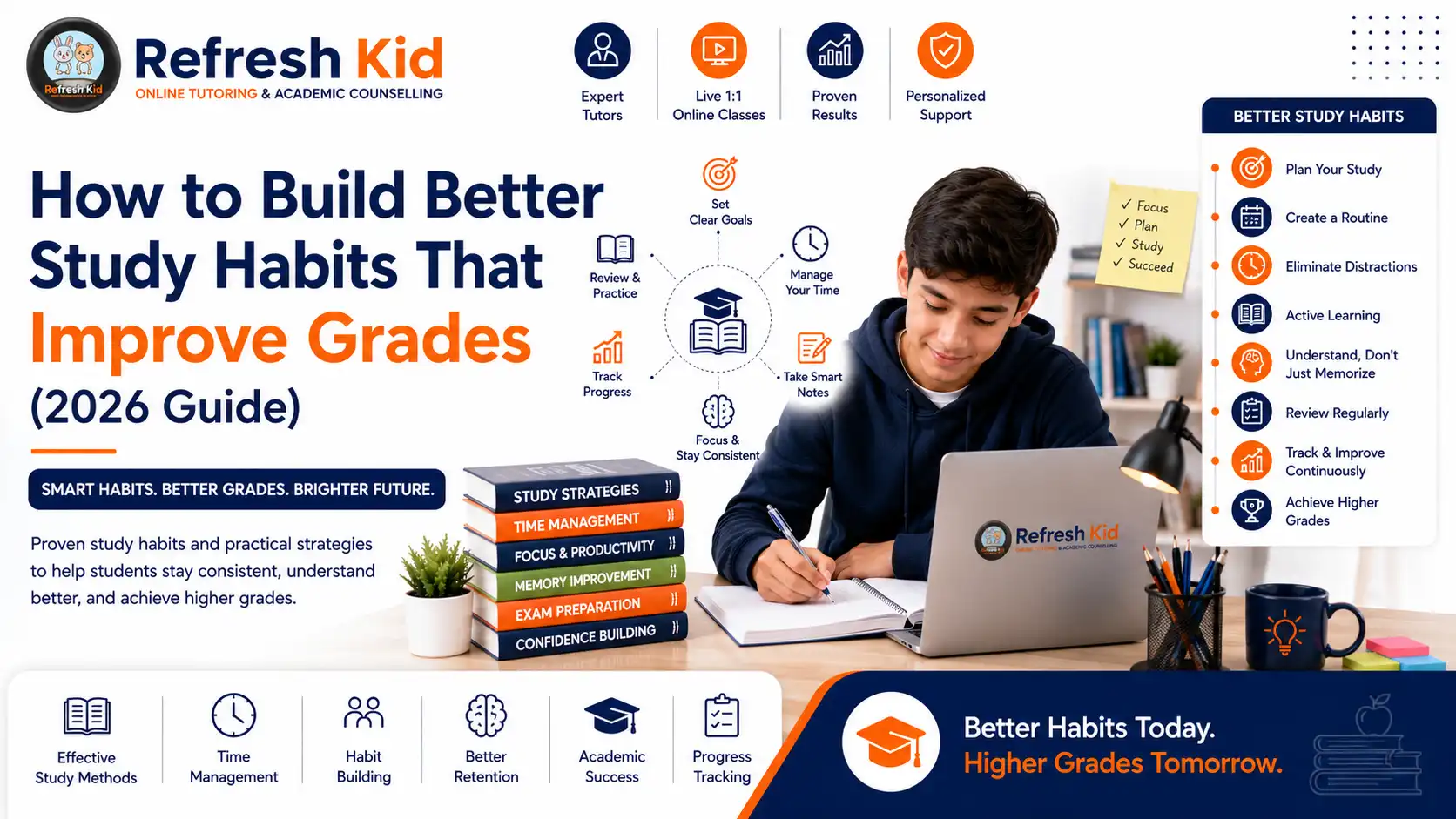
Strong Study Habits Start With a Clear System
Consistent routine, distraction-free space, subject-specific strategy, and regular parent check-ins for lasting academic growth.
Why Study Habits Matter More Than Raw Talent
Parents often assume that a struggling student needs more tutoring hours or a harder push. In reality, most academic struggles trace back to weak study habits rather than weak ability. A student who reviews notes the night before a test, studies in front of a TV, or does homework without checking for understanding will underperform even if they understand the material.
The best academic outcomes come from students who have internalized a system: when to study, how to study, and how to check whether the studying actually worked. A student with average ability and strong study habits will consistently outperform a highly capable student with no structure at all.
Students Often Need a System, Not Just More Time
In many families, the instinct is to add more hours of homework help or tutoring when grades slip. But more hours without a system often leads to burnout instead of improvement. Parents should first ask: does my child have a study space, a schedule, a way to track what they've mastered, and a way to review mistakes?
A strong study-habits plan helps students answer important questions: What time of day am I most focused? How do I know if I actually understood the material? Which subjects need active practice versus review? How do I avoid cramming the night before a test?
Common Study Struggles by Age Group
Study habit challenges look different depending on a child's age and grade level. A strong parenting article should speak directly to the specific struggles families are facing at each stage.
| Age / Grade Level | Common Struggle | Best Habit to Build |
|---|---|---|
| Elementary (K-5) | Short attention span, disorganized homework routine | Fixed homework time, simple checklists, reading routine |
| Middle School (6-8) | Losing track of assignments, weak note-taking | Planner use, active note-taking, weekly review sessions |
| Early High School (9-10) | Balancing multiple subjects, procrastination | Subject-specific study blocks, spaced review |
| AP & Test-Prep Years (11-12) | Cramming, poor time management under pressure | Practice-test routines, timed review cycles, error logs |
| College-Bound Seniors | Independent study skills not yet developed | Self-paced review, accountability check-ins, goal tracking |
Study Skills Support for Every Age
Refresh Kid supports K-12 students in building routines, note-taking skills, and subject mastery at every stage.
What a Strong Study Routine Actually Looks Like
Many families try generic tips like "study for 30 minutes a day" without a deeper structure. The difference between a routine that works and one that fails is whether it has clear checkpoints. Parents should look for consistency, subject-specific technique, and a feedback loop.
1. A Fixed, Distraction-Free Time and Place
The brain builds habits faster when study happens at the same time and place every day. A quiet desk, phone out of reach, and a consistent start time matter more than the exact number of hours.
2. Active Recall Instead of Passive Review
Rereading notes feels productive but teaches little. Practice problems, flashcards, and self-quizzing force the brain to retrieve information, which is what actually builds retention.
3. Regular Feedback and Progress Tracking
Students improve fastest when they know exactly what they got wrong and why. Weekly review of mistakes, guided by a teacher or parent, closes gaps before they compound.
4. A Plan That Matches the Subject
Math requires practice problems. Reading requires comprehension checks. Science requires diagrams and application. A one-size-fits-all study method rarely works across every subject.
Subject-Specific Study Strategies That Actually Work
One of the biggest mistakes parents make is treating all homework the same way. A child who "studies" for math by rereading the textbook is not actually practicing the skill that will be tested. Each subject rewards a different kind of practice.
Building the right habit for each subject early prevents frustration later, especially once coursework becomes more demanding in middle and high school.
| Subject | Why Generic Studying Fails | Best Study Approach |
|---|---|---|
| Math | Reading examples feels like understanding but does not build problem-solving speed | Daily practice problems, mistake review, timed drills |
| Reading / ELA | Passive reading skips comprehension checks | Summarizing paragraphs, vocabulary practice, guided questions |
| Science | Memorizing facts without understanding relationships | Diagrams, cause-and-effect mapping, applied practice questions |
| Writing | Writing once and never revising limits improvement | Draft, feedback, revise cycle with a teacher or tutor |
| Test Prep (SAT/ACT/AP) | Cramming content without timed practice ignores pacing | Timed practice sets, error logs, spaced review |
Study Skills by Subject
The right technique changes depending on what is being learned and how it will be tested.
Math
Practice problems, error review, and timed drills.
Reading
Summarizing, vocabulary, and guided questions.
Science
Diagrams, cause-and-effect, and applied practice.
Writing
Draft, feedback, and revision cycles.
Test Prep
Timed sets, pacing strategy, and error logs.
Organization
Planners, checklists, and weekly review sessions.
Study Habits That Matter Most for Test Prep
Standardized tests and AP exams reward a different set of habits than daily homework does. Students who only study content without practicing timing and pacing often underperform relative to their actual knowledge. Strong test-prep habits combine content review with structured, timed practice.
The students who improve the most usually do not wait until the last few weeks before the exam. They begin early, identify weak areas through practice tests, and follow a consistent review cycle rather than cramming.
| Grade | What to Focus On | Recommended Habit |
|---|---|---|
| 9th Grade | Building foundational study routines | Fixed homework time, weekly review sessions |
| 10th Grade | PSAT awareness, early skill gaps | Light timed practice, identify weak subjects |
| 11th Grade | Structured SAT/ACT/AP preparation | 12 to 16 week prep plan with error logs and timed sets |
| 12th Grade | Final exams, applications, retakes | Targeted review, avoid last-minute panic studying |
Grade-by-Grade Study Skills Roadmap
Study habits should evolve as a child grows. A checklist that works for a third grader will not serve a junior in high school preparing for AP exams. Building the right habits at the right stage prevents students from having to relearn how to study under pressure later.
For students aiming at strong academic outcomes, the foundation begins earlier than many families realize. Reading stamina, math fluency, and organizational skills built in elementary and middle school directly affect how easily a student adapts to AP courses and standardized testing later on.
Study Skills Roadmap by Stage
- Elementary school: Build a homework routine, reading habit, and simple checklists for daily tasks.
- Middle school: Introduce planners, active note-taking, and weekly review sessions.
- Early high school: Develop subject-specific study blocks and spaced review techniques.
- Junior year: Layer in test-prep habits: timed practice, error logs, and structured review cycles.
- Senior year: Shift toward independent study skills, self-paced review, and light accountability check-ins.
Study Skills Growth Roadmap
From simple homework routines through independent, exam-ready study habits.
Elementary
Homework routine, reading habit, and simple checklists.
Middle School
Planners, active note-taking, and weekly review.
Early High School
Subject-specific study blocks and spaced review.
Junior Year
Timed practice, error logs, and structured review.
Senior Year
Independent study skills and self-paced review.
Self-Study vs. Guided Support
Self-study can work well once a student has already internalized strong habits. But for students who are still building those habits, unstructured self-study often leads to frustration, procrastination, and inconsistent results. For busy families, guided support can build the routine faster and more reliably.
| Factor | Guided Study Support | Unstructured Self-Study |
|---|---|---|
| Accountability | Built-in through regular sessions | Depends entirely on the student |
| Feedback on mistakes | Immediate, expert-guided | Often delayed or missed entirely |
| Habit formation speed | Faster with structured routine | Slower and less consistent |
| Parent visibility | Weekly reports and check-ins | Varies, often unclear |
| Subject-specific technique | Taught explicitly by a teacher | Often generic across all subjects |
Parent Checklist: Building Better Study Habits at Home
Routine
- Is there a fixed time and place for studying each day?
- Are distractions like phones removed during study time?
- Does the routine stay consistent even on busy days?
Technique
- Is the child using active recall instead of just rereading?
- Does the study method match the subject being studied?
- Are practice problems and self-quizzing part of the routine?
Feedback
- Does the child review mistakes, not just correct answers?
- Is there a weekly check-in on what improved?
- Can the child explain what they still find difficult?
Long-Term Growth
- Does the routine evolve as the child moves up in grade level?
- Is there a plan for AP or standardized test preparation?
- Is the child gradually taking more ownership of their own study plan?
Why Families Choose Refresh Kid to Build Better Study Habits
Refresh Kid supports K-12 students online with a structure that turns generic advice into a real, personalized routine. Instead of guessing which study method will work, families get a plan built around the student's grade level, subjects, and goals, guided by a live teacher who tracks progress every week.
Live US-Certified Teachers
Students work with real teachers who model active study techniques and correct bad habits early.
Weekly Parent Reports
Parents receive clear updates on what was taught, which habits improved, and what still needs attention.
Subject-Specific Coaching
Refresh Kid tailors study strategy to each subject, from math practice sets to reading comprehension and essay revision.
Test-Prep Study Systems
Students build timed-practice habits and error logs well before SAT, ACT, or AP exam season begins.
K-12 Coverage
Families can build routines for elementary foundations, middle school organization, and high school independence in one place.
3,000+ Students Served
Refresh Kid has supported thousands of students with over 900,000 learning hours across K-12 subjects.
Frequently Asked Questions
Start with a fixed, distraction-free study time and place, then add active recall techniques like practice problems and self-quizzing. Weekly review of mistakes and consistent feedback from a parent or tutor helps turn a short-term change into a lasting habit.
This is often a study-habits issue rather than a knowledge gap. Passive review like rereading notes can create a false sense of understanding. Active recall, timed practice, and error review are usually what closes the gap between knowing the material and performing well under test conditions.
Elementary students benefit most from a fixed homework routine, a simple daily reading habit, and basic checklists to track completed tasks. These foundational habits make later organizational skills, like using a planner, much easier to build.
Most students need several weeks of consistent repetition before a new study habit feels automatic. Progress is usually visible within two to four weeks, but full consistency, especially under academic pressure, often takes a full semester of practice.
Yes. Refresh Kid teachers model active study techniques during sessions, including note-taking, error review, and subject-specific strategies, so students build lasting habits alongside subject mastery.
Absolutely. Strong students often use better study systems to prepare for AP exams, improve SAT/ACT scores, and manage a heavier course load without burning out. Study habits are not only for students who are struggling.
For most subjects, short daily active-recall sessions of 15 to 20 minutes are more effective than a single long weekly review. Spacing practice out over several days improves long-term retention compared to cramming everything into one sitting.
The most common mistake is adding more study hours without addressing the underlying technique. Increasing time spent on passive review, like rereading, rarely improves results. Fixing the method first, then adjusting time, produces much faster improvement.
Ask whether the tutor teaches study techniques explicitly, whether progress is reported weekly, whether the approach is customized by subject, and whether the plan evolves as the student moves up in grade level.
Families can visit www.refreshkid.com to request a free demo class or academic assessment for their child.
Ready to Build Better Study Habits?
Whether your child needs a daily routine, subject-specific strategy, or a structured test-prep plan, Refresh Kid helps families build lasting study habits with live US-certified teachers and clear weekly parent communication.