
What Are Factors?
Factors are numbers you can multiply together to get another number. If a number can be divided evenly by another number, that number is a factor.
[caption id="attachment_657" align="alignleft" width="300"]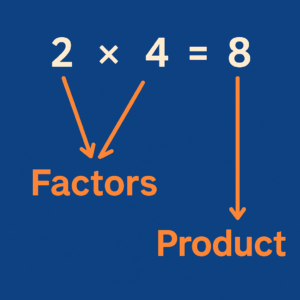 Understanding Multiplication[/caption]
Example:
Understanding Multiplication[/caption]
Example:
Understanding Multiplication[/caption]
Example:
- Factors of 12 are 1, 2, 3, 4, 6, and 12 because:
- 1 × 12 = 12
- 2 × 6 = 12
- 3 × 4 = 12
How to Find Factors of a Number
Step 1: Start with 1 and the Number Itself
Every number has 1 and itself as factors.Step 2: Check for Divisibility
Divide the number by smaller numbers starting from 2. If there’s no remainder, the divisor is a factor.Step 3: Continue Checking
Keep checking divisibility until you reach the number’s square root. Example Table:| Number | Factors |
| 15 | 1, 3, 5, 15 |
| 24 | 1, 2, 3, 4, 6, 8, 12, 24 |
| 36 | 1, 2, 3, 4, 6, 9, 12, 18, 36 |
Examples and Solutions
Example 1: Find Factors of 18
- Divide 18 by 1, 2, 3, 6, 9, and 18.
- Factors of 18: 1, 2, 3, 6, 9, 18
Example 2: Find Factors of 20
- Divide 20 by 1, 2, 4, 5, 10, and 20.
- Factors of 20: 1, 2, 4, 5, 10, 20
Example 3: Find Factors of 28
- Divide 28 by 1, 2, 4, 7, 14, and 28.
- Factors of 28: 1, 2, 4, 7, 14, 28
Types of Factors
1. Prime Factors
- Factors that are prime numbers (numbers greater than 1 that only have 1 and themselves as factors).
- Example: Prime factors of 18 are 2 and 3, because:
- 18 = 2 × 3 × 3 (prime factorization)
2. Common Factors
- Factors that two or more numbers have in common.
- Example: Common factors of 12 and 18 are 1, 2, 3, and 6.
3. Greatest Common Factor (GCF)
- The largest factor that two or more numbers share.
- Example: GCF of 24 and 36 is 12 because 12 is the biggest number that evenly divides both 24 and 36.
4. Composite Factors
- Factors that are not prime numbers (they have more than two factors).
- Example: In factors of 18 (1, 2, 3, 6, 9, 18), numbers like 6, 9, and 18 are composite.
5. Unique Factors
- Factors that are only counted once in factor lists.
- Example: Even though 3 appears multiple times in the prime factorization of 18, it is counted only once as a unique factor.
Why Are Factors Important?
Factors help with:- Simplifying fractions
- Solving equations
- Finding multiples and divisors
Quick Tips to Remember Factors
- Even Numbers: Always have 2 as a factor.
- Odd Numbers: Never have 2 as a factor.
- Zero: Every number is a factor of 0.
- One: Is a factor of every number.
Practice With Refresh Kid
Want to practice more?
We make math fun and easy at Refresh Kid LLC!
Check out:
-
Free Math Worksheets